
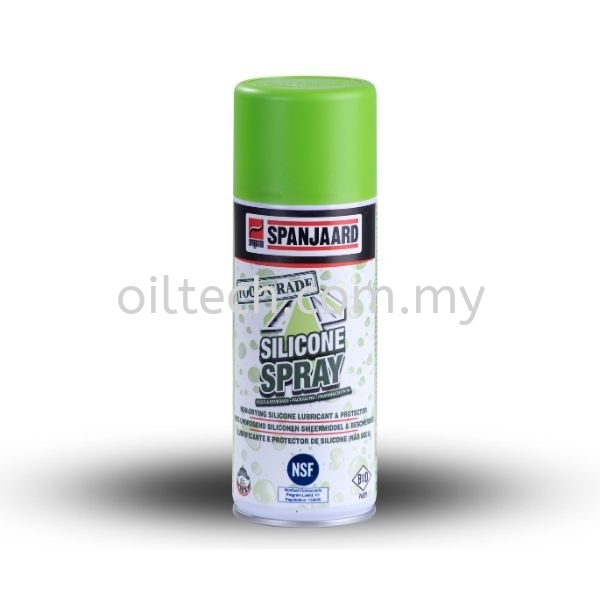
Food Grade Silicone Spray - Spanjaard Malaysia
Specifications
Details
Spanjaard Food Grade Silicone Spray Compliance Guide
TL;DR: Spanjaard Food Grade Silicone Spray is an NSF H1 registered 400ml aerosol fluid formulated for incidental contact in food and pharmaceutical processing equipment. It eliminates friction in packaging lines and conveyor chutes operating under high tropical humidity across facilities in Malaysia.
Technical Data & Compliance Benchmarks
-
NSF Registration: Category H1 (Registration No. 139905) for incidental food contact.
-
FDA Compliance: Raw materials strictly comply with FDA 21 CFR 178.3570 standards.
-
Religious & Cleanroom Certifications: Halaal certified (Independent Halaal Trust) and Kosher certified (Parev).
-
Kinematic Viscosity: 500 cSt at 25°C (Brookfield method).
-
Flash Point: 315°C (ASTM D56 method).
-
Pour Point: -50°C.
-
Density: 0.97 g/cm³ (ASTM D792 method).
-
Thermal Conductivity: 0.15 W·K⁻¹m⁻¹ (ASTM D2717 method).
-
Volatility: < 2.0% (230°C for 2 hours).
-
Refractive Index: 1.4035 (ASTM 1218 method).
-
Dielectric Constant: 2.74 (25°C / 100 Hz).
-
Surface Tension: 21.1 mN·m⁻¹ at 25°C.
-
Working Temperature Range: Continuous operation from -40°C to 200°C.
-
Appearance: Clear, colourless, non-staining fluid.
Machinery System Applications
-
Conveyors and Chutes: Eliminates surface tackiness, sugar build-up, and mechanical drag on stainless steel conveyor beds, slide rails, and chutes.
-
Cold Storage & Freezer Systems: Applied to cold room and refrigerator door seals to prevent elastomer embrittlement, maintaining elastomeric door flexibility to reduce refrigeration energy loss.
-
Polystyrene Resins & Packaging Machinery: Functions as a specialized plastics mould release agent during the high-speed thermal molding of polystyrene containers and pharmaceutical blister packs.
-
Mechanical Drive Components: Lubricates plastic gears, slide mechanisms, O-rings, elastomeric valves, rubber gaskets, latches, hinges, and light-load driving chains.
-
Bakery Ovens and Processing Utensils: Surface application prevents carbonized organic adhesion, allowing simplified washdown procedures.
-
Application Boundaries: Not designed for heavy-load metallic gear drives operating beyond the extreme pressure envelope, nor for non-incidental food contact areas exceeding 200°C.
Why the Engineering Specification Works
The formulation relies on a high-purity synthetic silicone polymer structure delivering a low surface tension (21.1 mN·m⁻¹). This low surface tension allows instant wet-out and complete film formation across low-energy elastomeric substrates and polished metals.
Under continuous tropical humidity and high ambient thermal loads common in Malaysian manufacturing environments, the inert silicone backbone resists moisture emulsification and chemical breakdown. The chemical structure retains an ultra-low volatility profile (< 2.0% loss at 230°C over 2 hours) and maintains fluid integrity across an extreme working temperature bandwidth of -40°C to 200°C.
Procurement & MRO Suitability Matrix
-
Recommended: High-Speed Food Packaging Facilities — Requires NSF H1 incidental contact verification for primary or secondary packaging lines.
-
Unsuitable: Heavy Load Steel-on-Steel Gearboxes — Systems requiring high-viscosity extreme pressure (EP) mineral or synthetic gear lubricants.
-
Recommended: Pharmaceutical Cleanrooms — Demands non-staining, clear lubricant sprays compliant with international cleanliness standards.
-
Unsuitable: Post-Assembly Painting Lines — Environments where ambient silicone mist causes severe surface coating flaws like fish-eye defects.
-
Recommended: Cold Storage Warehousing — Needs low pour point (-50°C) lubricants to keep elastomeric door seals flexible.
-
Unsuitable: Continuous Submerged High-Load Bearings — Submerged mechanical components requiring specialized water-insoluble heavy grease pastes.
System Preparation & Fluid Introduction SOP
-
Surface Isolation & Cleaning: Isolate equipment electrical feeds. Clean target surfaces (plastic gears, slides, door seals, mold cavities) to strip existing carbonized residue, organic buildup, or residual hydrocarbon greases.
-
Aerosol Preparation: Shake the aerosol canister vigorously to ensure uniform dispersion of the silicone fluid inside the propellant delivery system.
-
Application Protocol: Hold spray nozzle approximately 20–30 cm from the targeted mechanism (e.g., O-rings, valve stems, slide rails) and apply liberally in short, controlled passes.
-
Wipe Down Excess: Allow the solvent carrier to flash off briefly. Wipe off excess wet fluid from non-contact zones using a clean, lint-free microfiber cloth.
-
System Re-commissioning: Restore power to the conveyor drive or molding machine and cycle the mechanism slowly through its mechanical stroke before ramping up to continuous production speeds. Reapply as dictated by routine preventive maintenance schedules.
Common Operational Faults to Avoid
-
Over-Application on High-Speed Belt Surfaces: Excessive spraying onto primary drive belts can lower kinetic friction coefficients, inducing belt slippage across drive pulleys.
-
Application Near Unmasked Paint Spray Booths: Spraying airborne silicone particles into non-isolated coating zones causes micro-surface contamination on freshly painted industrial components.
-
Failure to Wipe Excess Fluid in High-Dust Zones: Leaving heavy wet pooling on open conveyor guides can entrap airborne particulate matter, resulting in an abrasive slurry that accelerates mechanical wear.
Environmental Regulations & Handling Safety
Waste aerosol canisters and unused liquid residues must be handled in full compliance with the Department of Environment (DOE) Malaysia under the Environmental Quality (Scheduled Wastes) Regulations 2005.
Technical Asset Availability
Official Spanjaard Technical Data Sheets (TDS) and Material Safety Data Sheets (MSDS/SDS) are available for plant engineering auditing, HACCP compliance verification, and quality assurance inspections upon request.
Engineering FAQ
Q: Is Spanjaard Food Grade Silicone Spray suitable for direct incidental contact with halal food processing lines in Malaysia?
A: Yes, the aerosol formulation holds NSF H1 registration (No. 139905) for incidental food contact compliant with FDA 21 CFR 178.3570, and is certified Halaal by the Independent Halaal Trust.
Q: What packaging sizes are standard for bulk industrial maintenance procurement?
A: The product is supplied in 400ml aerosol cans under Product Code 53750405, packaged in cases containing 2 shrink-wrapped packs of 6 cans (12 cans per master carton).
Q: What is the continuous temperature threshold for this silicone lubricant inside bakery or cold room applications?
A: The operational working temperature ranges continuously from -40°C up to 200°C, featuring a pour point of -50°C and a flash point of 315°C (ASTM D56).
Secure Your Industrial Supply with Oiltech Malaysia
As an authorized distributor of high-performance industrial solutions, Davor Sdn Bhd ensures reliable stock availability and comprehensive compliance support for factories across Malaysia.
How to Order / Request Pricing:
-
Speak to a Sales Engineer: Call our Puchong headquarters for immediate technical fulfillment support.
-
Instant Chat: Click our WhatsApp Support Link to check live stock levels and price.
View more about Food Grade Silicone Spray - Spanjaard Malaysia on main site